
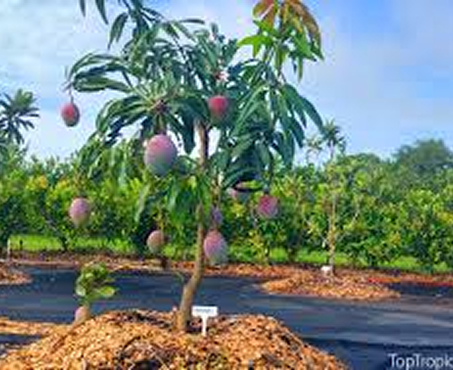
The mango is inextricably connected with the folklore and religious ceremonies of India. Buddha himself was presented with a mango grove that he might find repose in its grateful shade. The name mango, by which the fruit is known in English- and Spanish-speaking countries, is most likely derived from the Malayam manna, which the Portuguese adopted as manga when they came to Kerala in 1498 for the spice trade. Probably because of the difficulty in transporting seeds (they retain their viability a short time only), the tree was not introduced into the Western Hemisphere until about 1700, when it was planted in Brazil; it reached the West Indies about 1740.
The subject of fruit and nut production deals with intensive culture of perennial plants, the fruits of which have economic significance (a nut is a fruit, botanically). It is one part of the broad subject of horticulture, which also encompasses vegetable growing and production of ornamentals and flowers. This article places further arbitrary limitations in that it does not encompass a number of very important perennial fruit crops covered elsewhere, including vanilla, coffee, and the oil-producing tung tree and oil palm (see coffee, fat and oil processing, wine, and articles on individual plants.
Botanists define a fruit in broad terms as the fleshy or dry ripened ovary surrounding the seed of a plant. A pomologist, or specialist in the science and practice of fruit growing, defines it somewhat more narrowly as the fleshy edible part of a perennial plant associated with development of the flower. A nut is any seed or fruit consisting of a kernel, usually oily, surrounded by a hard or brittle shell. Most edible nuts—e.g., almond, walnut, cashew, pecan, pistachio, etc.—are well known as dessert nuts. Not all nuts are edible. Some, used as sources of oil or fat, may be regarded as oil seeds; others are used for ornament. The botanical definition of a nut, based on features of form and structure (morphology), is more restrictive: a hard, dry, one-celled, one-seeded fruit that does not split open at maturity. Among the nuts that fit both the botanical and popular conception are the acorn, chestnut, and filbert; other so-called nuts may be botanically a seed (Brazil nut), a legume (peanut [groundnut]), or a drupe (almond and coconut). In this article the term nut is used in its broadest sense unless otherwise indicated.
Reviews
There are no reviews yet.